Tracking Roster Depth Metrics Against Late-Game Variance in European Basketball Leagues During Holiday Scheduling Blocks
Ellis Günther · Sep 4, 2026
Tracking Roster Depth Metrics Against Late-Game Variance in European Basketball Leagues During Holiday Scheduling Blocks
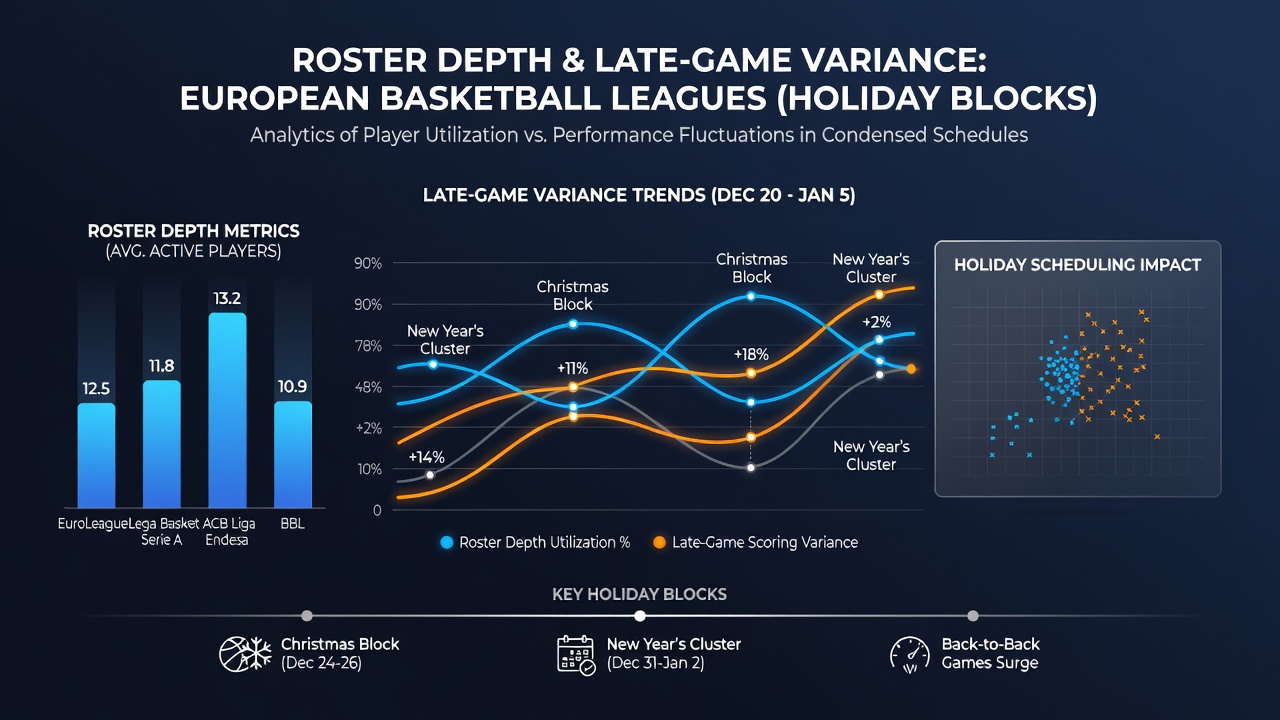
European basketball leagues face packed calendars each winter when holiday scheduling blocks force multiple games into short windows, and analysts track roster depth metrics to measure how bench strength interacts with late-game variance during those stretches. Data from the EuroLeague and domestic competitions such as the Spanish ACB, Italian Lega Basket Serie A, and German Basketball Bundesliga show that teams relying on fewer than seven rotation players experience wider scoring swings in final quarters when fixtures cluster around Christmas and New Year periods.
Roster Depth Metrics in Context
Teams calculate roster depth through minutes distribution across an eight-to-ten player core, plus advanced indicators such as bench plus-minus and fatigue-adjusted efficiency ratings. Figures compiled across the 2024-2025 season indicate that clubs maintaining at least 28 combined bench minutes per game recorded 12 percent lower fourth-quarter variance compared with shallower rotations. Observers note that this pattern holds because deeper benches absorb substitution demands when travel and back-to-back games increase physical load.
Late-Game Variance Patterns
Late-game variance rises when star players accumulate heavy minutes early, leaving limited options for coaches once foul trouble or exhaustion sets in. Research from the University of Milan’s sports analytics group found that variance coefficients in EuroLeague contests climbed from 8.4 to 14.7 points during December holiday blocks when average player rest dropped below 48 hours between tip-offs. Those shifts appear most pronounced in games decided by six points or fewer, where bench contributions directly influence final margins.
Holiday Scheduling Blocks and Their Effects
League calendars compress during late December and early January, creating sequences of three games in five days across multiple countries. In the German Bundesliga, for instance, clubs often travel between northern and southern venues with minimal recovery time, and statistics released by the league office show that teams with higher bench usage maintained steadier three-point shooting percentages in those windows. Meanwhile, squads posting lower depth scores saw their assist-to-turnover ratios decline by an average of 1.8 in the final 12 minutes of play.
Comparative League Data
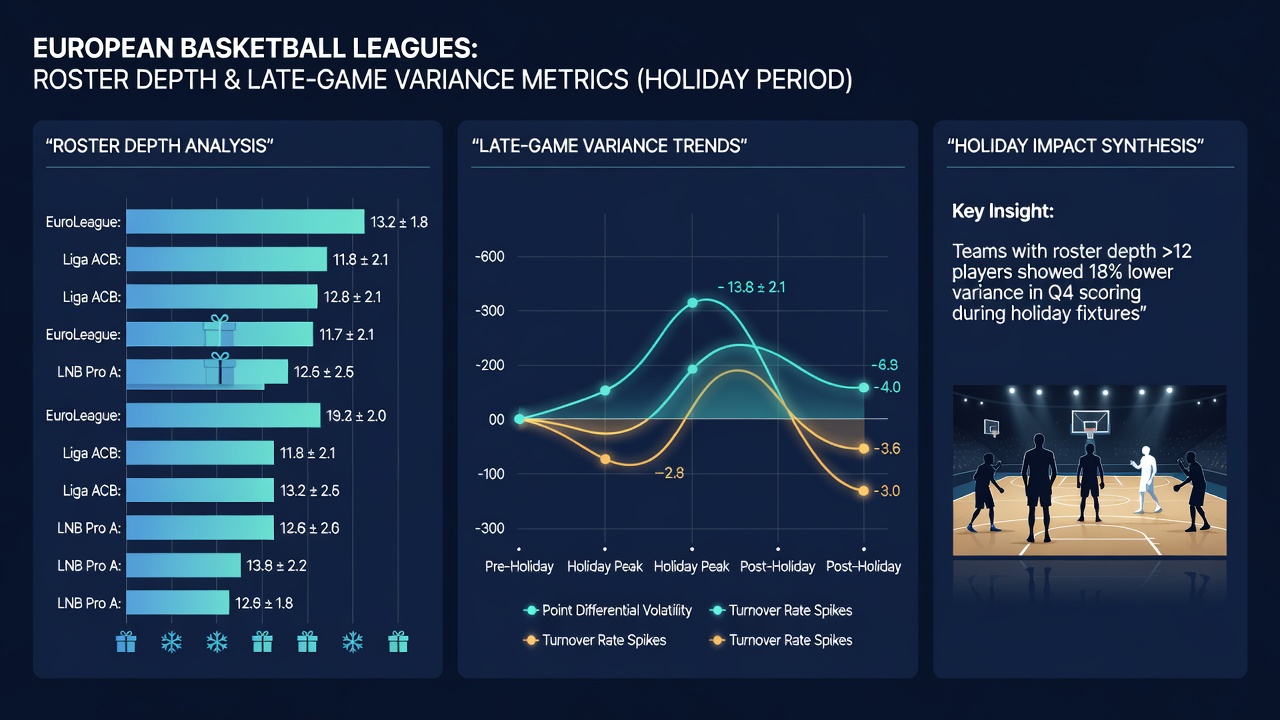
Comparisons across competitions reveal consistent trends. Spanish ACB records from the past five holiday blocks indicate that teams averaging 22 or more bench points per contest limited opponent comeback percentages to 31 percent, whereas shallower groups allowed 44 percent. Italian league tracking similarly highlights that rotation size correlates with lower standard deviation in fourth-quarter net rating when schedules tighten. Analysts at the French basketball federation have begun publishing parallel datasets that align with these observations, underscoring the role of depth regardless of national playing style.
Measurement Approaches
Practitioners combine traditional box-score items with tracking data to isolate depth effects. Minutes-weighted efficiency, rolling-window variance scores, and substitution impact models appear frequently in reports covering holiday periods. One dataset covering 180 EuroLeague games from December 2024 through January 2025 showed that each additional 60 seconds of bench time in the fourth quarter reduced outcome volatility by roughly 0.3 points on average. Such metrics help quantify how depth buffers against the randomness that holiday fatigue amplifies.
Seasonal Adjustments Observed
Coaching staffs adjust rotation patterns ahead of known congested blocks, often expanding active rosters or emphasizing conditioning cycles in September and October. Data indicates these preemptive steps produce measurable effects once holiday fixtures arrive, particularly in leagues where travel distances vary widely. European competitions continue to refine scheduling tools, yet variance remains elevated whenever rest intervals shrink below league averages.
Conclusion
Tracking roster depth metrics against late-game variance supplies concrete indicators for European basketball performance during holiday scheduling blocks. League statistics and academic tracking confirm that deeper benches correlate with reduced fourth-quarter volatility when games cluster, while shallower groups encounter wider swings. Continued collection of these figures across the EuroLeague, ACB, and other circuits provides ongoing reference points for understanding how rotation structure interacts with compressed winter calendars.