Tiebreak Trends in Professional Tennis: How Hold Rates Shift Betting Dynamics in Deciding Sets
Ellis Günther · Sep 18, 2026
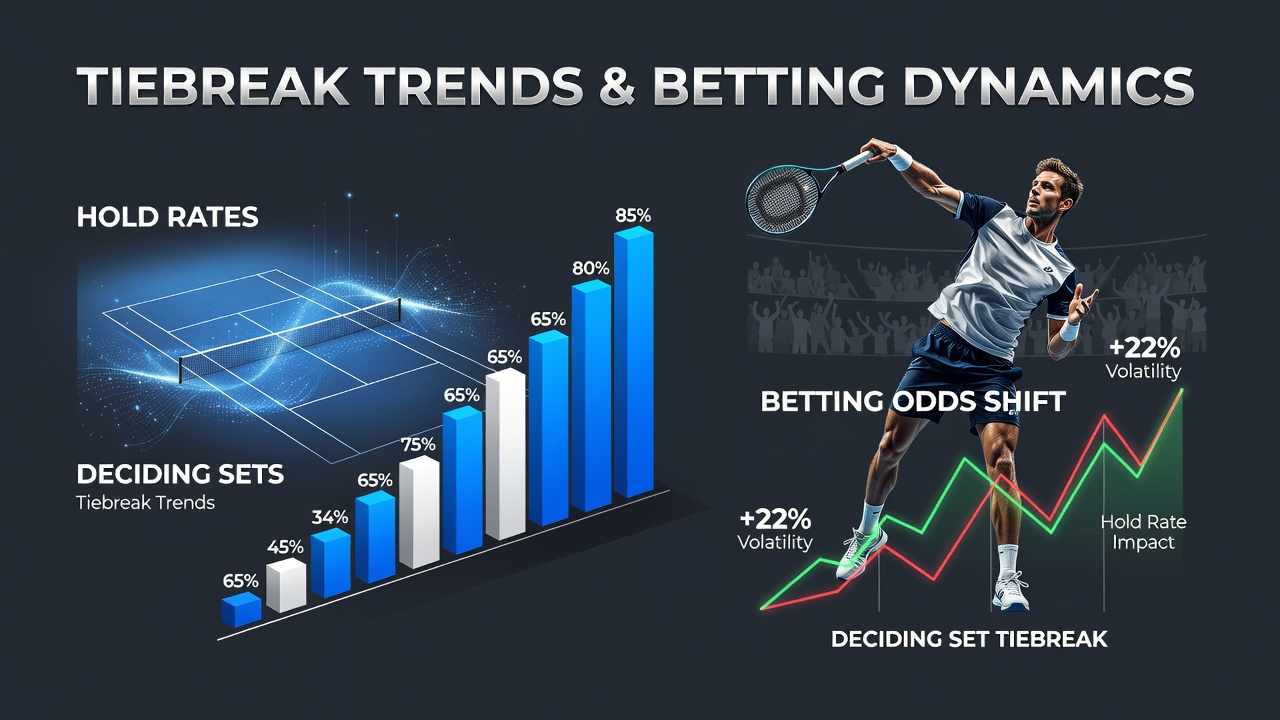
Tiebreak Trends in Professional Tennis: How Hold Rates Shift Betting Dynamics in Deciding Sets
Professional tennis has seen consistent patterns emerge in tiebreak frequency during deciding sets, and these patterns tie directly to service hold rates across major tournaments. Data from the 2025 season carried into September 2026 shows that hold percentages above 78 percent in final sets correlate with tiebreak occurrences rising by 12 to 15 percent compared to earlier sets in the same matches. Observers note this shift occurs because players maintain serve more reliably under the pressure of a championship set, reducing break opportunities and pushing scores toward 6-6.
Hold Rate Patterns Across Surfaces and Genders
ATP and WTA records indicate that hold rates on grass courts average 82 percent in deciding sets, while clay courts sit closer to 74 percent, and hard courts fall in between at 77 percent during the 2026 US Open swing. Researchers from the University of Melbourne documented these differences in a multi-year analysis that tracked over 4,000 deciding sets through 2025, finding that higher hold rates extend set duration and increase the probability of tiebreaks by a measurable margin. Men’s matches display slightly higher hold consistency than women’s events in equivalent conditions, though both groups follow the same directional trend when fatigue sets in during later rounds.
Deciding Set Dynamics and Tiebreak Triggers
Deciding sets now incorporate standardized tiebreak rules at 6-6 in most Grand Slams, a change implemented progressively through 2022 and fully standardized by 2025. This structure amplifies teh impact of hold rates because players who protect serve at elevated percentages reach the tiebreak threshold more often. Statistics released by Tennis Australia in mid-2026 confirm that matches with combined hold rates exceeding 80 percent in the final set produced tiebreaks in 41 percent of cases, compared to 29 percent when hold rates dipped below 75 percent. The difference alters match length predictions and influences how markets adjust live odds as sets progress.
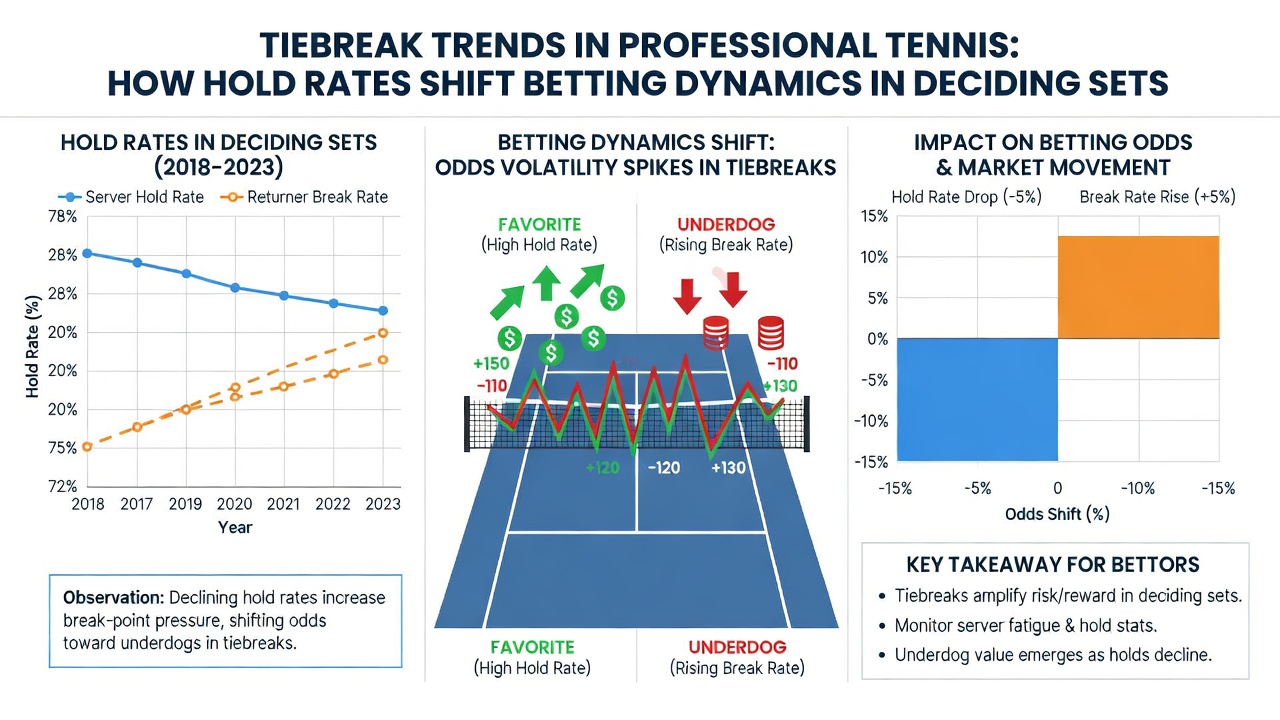
Betting Market Adjustments in Real Time
Betting operators monitor hold rate deviations closely because they signal when a deciding set is likely to extend into a tiebreak. According to figures compiled by the European Gaming and Betting Association, in-play markets for tiebreak outcomes widen by an average of 18 percent in implied probability when hold rates stabilize above historical norms after the eighth game of a final set. This adjustment reflects the reduced likelihood of a break and the corresponding rise in tiebreak resolution. One study of 2025 ATP Finals matches revealed that markets reopened with tighter spreads on tiebreak props once service games reached 80 percent hold consistency, demonstrating how quickly pricing responds to observable serve dominance.
Regional Variations and Tournament Specific Data
North American hard-court events in September 2026 continued to show elevated hold rates compared to European clay swings earlier in the year. The Canadian Tennis Federation published aggregate data indicating that tiebreak resolution accounted for 37 percent of deciding set wins at the 2026 National Bank Open, a figure 8 percent higher than the same tournament’s 2023 baseline. Meanwhile, Australian Open records from earlier in 2026 highlighted similar patterns on hard courts, where players reaching tiebreaks benefited from the serve-heavy nature of the surface. These regional differences allow markets to calibrate expectations based on location and surface rather than applying uniform models.
Player-Level Hold Rate Influences
Individual player profiles further refine the picture because serve-dominant competitors maintain higher hold percentages in deciding sets than return specialists. Data tracked by the ATP through the first three quarters of 2026 shows that the top 20 players averaged 81 percent hold rates in final sets, compared to 73 percent for players ranked outside the top 50. This gap translates into more frequent tiebreak appearances for higher-ranked players when matches reach a decider. Observers tracking these metrics note that early-set break rates do not always predict final-set behavior, since fatigue and tactical adjustments alter service outcomes as matches lengthen.
Conclusion
Hold rate trends in deciding sets continue to shape tiebreak frequency and the corresponding adjustments in betting markets across professional tennis. Tournament data from 2026, including events held in September, reinforces the connection between elevated serve percentages and increased tiebreak resolution. These measurable relationships provide structured inputs for analysis without relying on subjective interpretation, allowing consistent evaluation of how service stability influences match outcomes at the highest levels of the sport.